

The Suzuki Philosophy of Education
Often called the “mother-tongue” approach, Shinichi Suzuki developed his method after realizing that children naturally learn from their environment. He observed that children around the world master complex native languages through listening, absorption, and imitation. Believing music to be a language as well, Dr. Suzuki created a philosophy of early music education that mirrors how children acquire their first language. Core elements of the Suzuki approach include community learning, parental involvement, early instruction, learning by ear, listening, repetition, and review.

Community Learning
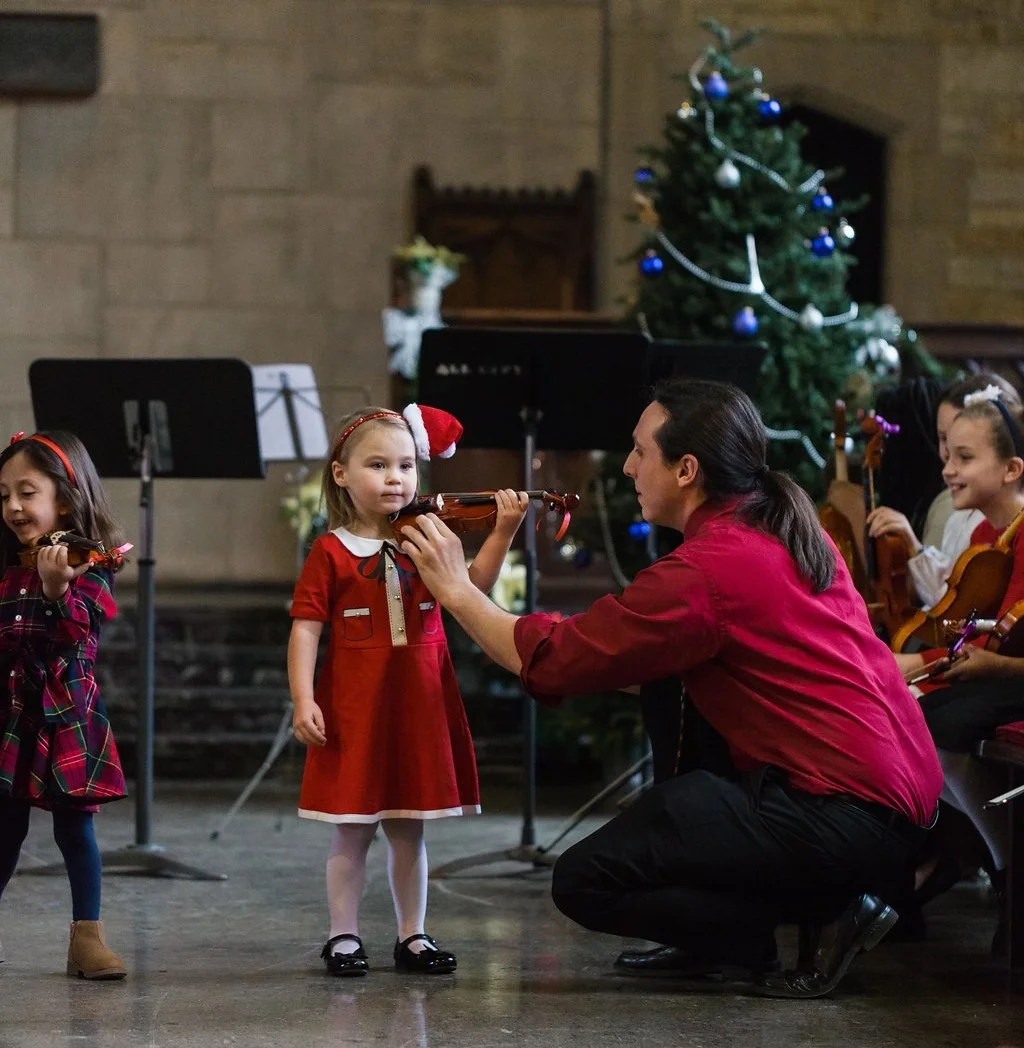
Group class in addition to private lessons is a cornerstone of the Suzuki method. Students who participate in group and private lessons advance through the repertoire at a faster pace and have more fun while doing so! Group learning reinforces the musical and technical concepts taught in private lessons while introducing the social aspect of music making. We find that the motivation students receive from each other often goes farther than that of the teacher or parent. The encouragement and support of a community of teachers, parents, and peers is part of what makes South Side Suzuki so special for our students.
“Man is a child of his environment”
Parental Involvement
The Suzuki method requires a three-way partnership between the student, teacher, and parent. Parents are expected to attend lessons, observe, take notes, and serve as the "home teacher." An involved Suzuki parent is the key to fostering a positive and motivational learning environment that leads to developing musical ability.
“Children learn to smile from their parents.”


Early Beginnings
The early years are crucial for developing mental processes and muscle coordination. Listening to music should begin at birth; formal training may begin as early as three years old. Parallel to mastering a language, we believe capitalizing on a child's ability to absorb sounds in the early developmental years to be greatly helpful in acquiring musical fluency. However, it is never too late to start and the Suzuki method can be applied to students of all ages!
Learning by Ear
Children learn to read only after they can speak, and similarly, they should develop basic technical skills on their instruments before learning to read music. Learning by ear frees them to focus on posture, tone, and expression rather than a page, helping them internalize music more naturally. Suzuki students who play “by ear” and “by heart” often develop a beautiful, mature tone from the earliest stages. Just as language is learned through repeated listening, musical understanding grows through daily exposure and immersion. Regular listening—especially to Suzuki repertoire and high-quality performances—helps students learn melodies quickly, develop accurate pitch and rhythm, and cultivate a refined tone.
Repetition and Review
The Suzuki method stresses the importance of repetition and review. Through consistent review of former pieces students create a repertoire in which they can strengthen old skills and learn new techniques.
“Knowledge is not skill. Knowledge plus ten thousand times is skill.”